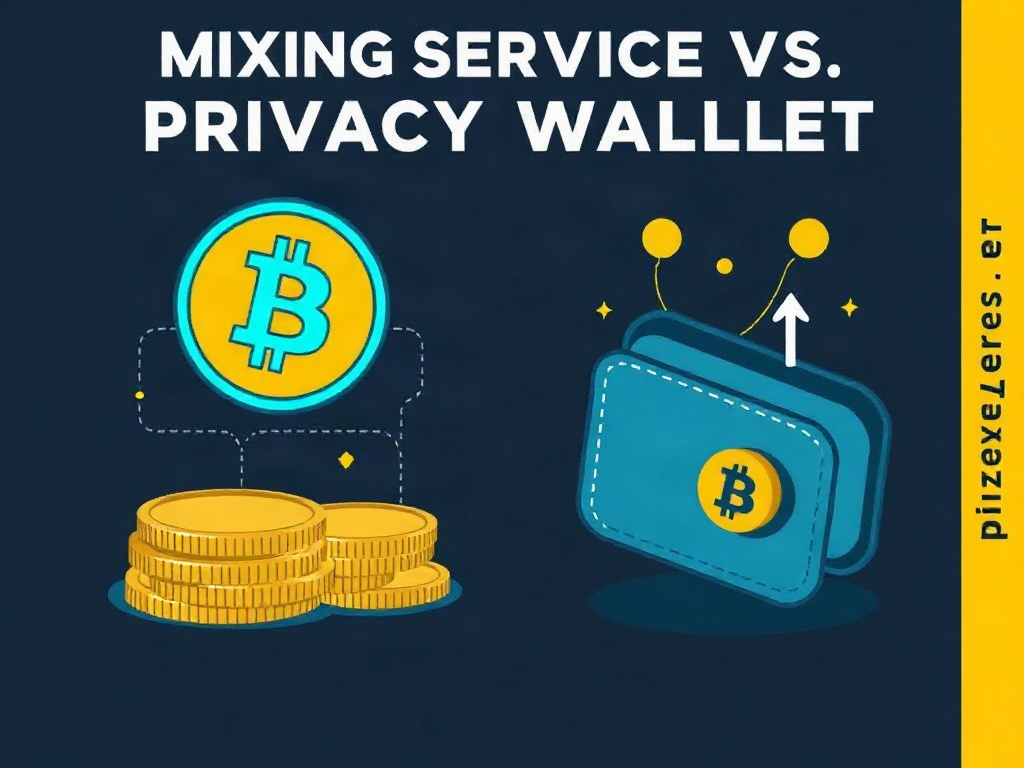
In the evolving landscape of cryptocurrency financial privacy, users frequently encounter a pivotal decision: whether to rely on a mixing service or a privacy wallet to obfuscate transaction trails. This mixing service vs privacy wallet comparison examines the fundamental mechanics, advantages, limitations, and risk profiles of both approaches, providing clarity for investors, developers, and privacy advocates alike. As blockchain analytics become increasingly sophisticated, understanding how each tool functions—and where they overlap or diverge—is essential for making informed choices that align with personal security goals and regulatory realities.
Cryptocurrencies like Bitcoin were originally designed with pseudonymous, rather than fully private, transaction models. Every transaction is recorded on a public ledger, and while wallet addresses do not directly reveal identities, sophisticated chain analysis can deanonymize users by correlating addresses, timing, and transaction amounts. This transparency has given rise to two primary countermeasures: mixing services that tumble coins to break traceability, and privacy wallets that integrate cryptographic techniques to shield transaction data from the outset. The following analysis dissects these mechanisms in depth.
Understanding Mixing Services
A mixing service, often referred to as a tumbler, is a third-party platform that accepts cryptocurrency from multiple users, blends the funds, and redistributes them to designated recipients. The core objective is to sever the on-chain link between sender and receiver by commingling coins in a way that makes heuristic analysis extremely difficult. When evaluating any mixing service vs privacy wallet comparison, the operational model of mixers is the first dimension to explore.
Centralized Mixing Services
Centralized mixers operate as businesses that hold user funds in custody during the mixing process. Users deposit coins into the mixer's pool, specify destination addresses, and receive an equivalent amount of "clean" coins after a delay. The primary advantage of centralized mixers is user convenience: intuitive interfaces, support for multiple cryptocurrencies, and often faster processing times. However, this model introduces significant trust requirements. The mixer operator has access to both incoming and outgoing transactions, creating a potential single point of failure or malicious intent. Historical incidents have demonstrated that centralized operators can absort funds, freeze withdrawals, or comply with law enforcement seizures, undermining the very privacy the user seeks.
Decentralized Mixing Protocols
Decentralized mixing protocols, such as CoinJoin implementations or privacy-focused decentralized exchanges, eliminate the need for a trusted third party. These protocols leverage cryptographic algorithms and peer-to-peer coordination to combine transactions without the mixer ever holding custody of the funds. Participants retain control of their private keys throughout the process, and the resulting transaction graph is inherently more resistant to analysis. While decentralized mixers enhance trust minimization, they often present steeper learning curves, higher technical requirements, and variable liquidity, which can impact usability for everyday users.
Understanding Privacy Wallets
Privacy wallets are software or hardware wallets designed from the ground up to prioritize user confidentiality. Unlike standard wallets that merely store and transmit addresses, privacy wallets integrate privacy-enhancing features directly into the signing and broadcasting process. This mixing service vs privacy wallet comparison segment explores how these wallets function and the trade-offs they entail.
Native Privacy Features
Many privacy wallets incorporate protocols such as CoinJoin, Confidential Transactions, or zk-SNARKs to obfuscate transaction metadata. CoinJoin, for instance, allows multiple users to combine their payments into a single transaction with multiple inputs and outputs, making it computationally expensive for analysts to determine which output corresponds to which input. Confidential Transactions mask the transaction amounts while preserving the ability to verify that inputs equal outputs. zk-SNARKs, used in certain privacy-centric blockchains, enable transaction validation without revealing any underlying data, including sender, receiver, and amount. Native implementation ensures that privacy is not an afterthought but a foundational layer of the wallet's architecture.
Integration with External Privacy Tools
Some wallets adopt a modular approach, allowing users to enable privacy features optionally or integrate with external protocols like Tor or I2P to mask IP addresses, or with decentralized mixing services via APIs. This flexibility can be advantageous for users who want granular control over when and how privacy measures are applied. However, it also introduces complexity: users must understand the interaction between the wallet's internal mechanisms and external tools, and misconfiguration can inadvertently expose metadata. Evaluating a wallet's default privacy posture versus its opt-in capabilities is a critical step in any mixing service vs privacy wallet comparison.
Key Differences: Functionality and Use Cases
The practical distinctions between mixing services and privacy wallets become most apparent when examining specific use cases, user skill levels, and desired outcomes. This section provides a detailed breakdown to inform the mixing service vs privacy wallet comparison discussion.
Transaction Volume and Frequency
Mixing services are often favored by users who need to privacy-enhance a one-time or infrequent large transaction. The act of depositing coins, waiting for the mixing process, and withdrawing clean funds is straightforward for occasional use. Privacy wallets, by contrast, are better suited for users who conduct regular on-chain activity and desire continuous privacy protection. A wallet that automatically employs CoinJoin on every outbound transaction, for example, ensures that every payment benefits from obfuscation without requiring manual intervention.
User Control and Custody
Custody is a defining differentiator. Centralized mixing services require users to entrust their funds to an external entity, introducing counterparty risk. Decentralized mixing protocols and privacy wallets both aim to preserve user control, but they do so through different mechanisms. Privacy wallets typically give users full ownership of private keys, with privacy features executed locally on the device. Decentralized mixers rely on smart contracts or peer-to-peer protocols, ensuring that no single party holds the funds during the mixing process. For users prioritizing self-sovereignty, privacy wallets and decentralized mixers represent the preferred pathways.
Anonymity Sets and Analysis Resistance
The strength of anonymity—the size and composition of the group of users whose transactions are indistinguishable—varies significantly. Mixing services can create large anonymity sets, especially centralized platforms with high user throughput, but the trust assumption remains a vulnerability. Decentralized mixing protocols depend on active participant numbers; low liquidity can result in smaller anonymity sets and reduced privacy guarantees. Privacy wallets that implement CoinJoin dynamically generate anonymity sets based on concurrent users, which can be highly effective during periods of network activity but may diminish during low-traffic intervals. Understanding these dynamics is essential for realistic threat modeling.
Security, Anonymity, and Trust Models
Beyond functionality, the security and trust frameworks underpinning mixing services and privacy wallets warrant careful examination. This portion of the mixing service vs privacy wallet comparison delves into risk mitigation and threat assessment.
Attack Vectors Targeting Mixing Services
Mixing services, particularly centralized ones, are attractive targets for cybercriminals and state actors. Common attack vectors include phishing to obtain user credentials, network surveillance to correlate deposit and withdrawal patterns, and regulatory seizure of server infrastructure. Even decentralized mixers are not immune; attackers may exploit smart contract bugs, perform front-running attacks, or flood the protocol with sybil identities to reduce anonymity set quality. Users must conduct thorough due diligence, examining a mixer's audit history, community reputation, and operational transparency.
Wallet Security Considerations
Privacy wallets face a different spectrum of risks. Software wallets residing on internet-connected devices are susceptible to malware, keyloggers, and clipboard hijacking that can compromise private keys. Hardware wallets mitigate many of these risks by keeping private keys offline, though users must still verify that the device's firmware is authentic and uncompromised. Additionally, privacy wallets that rely on external APIs or remote servers for transaction broadcasting may introduce attack surfaces if those endpoints are compromised. Best practices include using reputable wallet software, maintaining updated operating systems, and verifying transaction details before signing.
Trust and Verifiability
Verifiability of privacy claims is a shared challenge. Mixing service operators may publish proof-of-reserve data or audit reports, but independent verification often requires technical expertise. Privacy wallets can open-source their code, allowing the community to audit cryptographic implementations and identify potential backdoors or leaks. Transparency, whether through third-party audits or open-source development, serves as a critical proxy for trust in the mixing service vs privacy wallet comparison.
Legal, Regulatory, and Ethical Considerations
The regulatory environment surrounding privacy-enhancing tools has intensified globally. Governments and financial authorities increasingly view mixing services and privacy wallets through the lens of anti-money laundering (AML) and counter-terrorism financing (CTF) compliance. This section contextualizes the legal dimensions of the mixing service vs privacy wallet comparison.
Regulatory Scrutiny of Mixing Services
Many jurisdictions have enacted or proposed regulations targeting mixing services. In some regions, operating or using a mixer that obscures transaction trails is classified as a money transmission activity requiring licensing, or even as a prohibited practice under anti-money laundering statutes. Law enforcement agencies have successfully seized centralized mixer infrastructure and prosecuted operators for facilitating illicit fund flows. Users risk legal exposure not only from using prohibited services but also from associating with mixers that later fall under regulatory action. Staying informed about local laws and regulatory updates is paramount.
Privacy Wallet Compliance Landscapes
Privacy wallets, especially those integrating native privacy protocols, navigate a more nuanced regulatory terrain. While the software itself may be legal, its use can attract scrutiny if transaction patterns trigger AML alerts on exchanges or custodial services. Some wallet developers implement geofencing or optional privacy features to allow users to comply with regional regulations while retaining choice. Open-source wallets may also face pressure to incorporate compliance features, potentially compromising the privacy guarantees that define their value proposition. Users must balance the desire for privacy with the practical necessity of interacting with regulated on-ramps and off-ramps.
Ethical Dimensions
Beyond legality, ethical considerations surround the use of privacy tools in transparent financial ecosystems. Proponents argue that financial privacy is a human right, essential for protecting vulnerable populations, enabling free expression, and preserving economic autonomy. Critics contend that robust privacy mechanisms can hinder tax compliance, law enforcement investigations, and the integrity of financial markets. The mixing service vs privacy wallet comparison inevitably touches on this philosophical divide, urging users to reflect on their values and the broader societal implications of their technological choices.
Making the Right Choice: Practical Guidance
Armed with a comprehensive understanding of the technical, security, and regulatory facets, users can approach the mixing service vs privacy wallet comparison with

mixing service vs privacy wallet comparison: A Web3 Analyst’s Perspective on Anonymity and Compliance
As a technology researcher specializing in decentralized finance and Web3 infrastructure, I've observed the rapid evolution of privacy mechanisms designed to shield user activity on public blockchains. The tension between on-chain transparency and user confidentiality has given rise to two primary tooling categories: mixing services and privacy-focused wallets. While both aim to obfuscate transaction trails, their underlying architectures, risk profiles, and compliance implications differ substantially, making a deliberate mixing service vs privacy wallet comparison essential for any serious DeFi participant.
Mixing services, often implemented as smart contracts or off-chain relayers, aggregate multiple users' funds and redistribute them to break the on-chain link between sender and recipient. From a practical standpoint, they offer strong anonymity sets but introduce smart contract risk, centralization vectors if custodial, and potential regulatory scrutiny under AML frameworks. In contrast, privacy wallets typically integrate zero-knowledge proofs or stealth address protocols, giving users native control over their anonymity without surrendering custody of assets. This distinction matters: a mixing service vs privacy wallet comparison reveals that the former often trades convenience and immediate obfuscation for heightened counterparty risk, whereas the latter prioritizes user sovereignty and cryptographic privacy, albeit with a steeper learning curve and potential liquidity fragmentation.
For practitioners navigating this space, the choice hinges on the specific threat model: are you primarily concerned with blockchain analysis firms, or with jurisdictional compliance requirements? I advise weighing the trade-offs between auditability, user experience, and long-term sustainability. As regulators tighten scrutiny on privacy infrastructure, staying informed about both the technical merits and legal standing of these tools is not optional—it's a professional imperative. Ultimately, a balanced approach that leverages privacy wallets for routine interactions while reserving mixing services for high-stakes anonymity needs often represents the most pragmatic path forward in the current Web3 ecosystem.