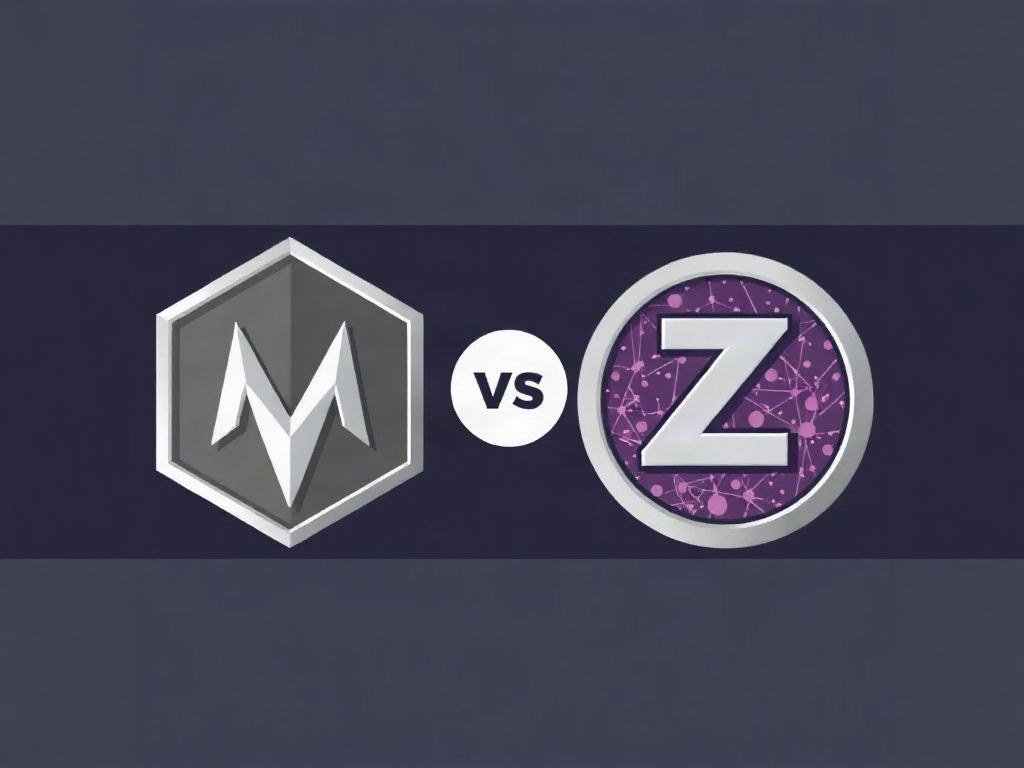
In the evolving landscape of decentralized finance and digital privacy, the debate between Monero and Zcash has become one of the most prominent discussions among cryptographers, investors, and privacy advocates. Both projects aim to obscure transaction details on a public ledger, but they employ fundamentally different cryptographic philosophies to achieve shielded transactions. Understanding these differences is essential for anyone seeking to navigate the nuances of privacy coins, evaluate risk, or simply comprehend how modern blockchain confidentiality operates. This article provides a detailed comparison of Monero vs Zcash shielded transactions, examining their underlying technologies, usability, privacy guarantees, and real-world implications.
The concept of shielded transactions refers to the ability to hide sender, receiver, and amount information on a transparent blockchain. While Bitcoin and Ethereum expose all data by default, privacy-focused coins integrate mechanisms that encrypt sensitive fields. The two leading implementations—Monero’s default privacy and Zcash’s optional shielded mode—represent contrasting design choices. Monero was built from the ground up with privacy as the default state, whereas Zcash introduced a flexible model allowing users to choose between transparent and shielded addresses. This core divergence shapes every aspect of their ecosystems, from transaction fees to regulatory scrutiny.
Understanding Shielded Transactions in Privacy Cryptocurrencies
What Makes a Transaction "Shielded"?
A shielded transaction encrypts the originating address, destination address, and transferred amount, recording only a cryptographic proof that the transaction is valid without revealing its contents. This is achieved through advanced zero-knowledge proofs or ring-based obfuscation techniques. The primary goal is to prevent blockchain analysis firms, surveillance entities, and even sophisticated from tracing the flow of funds. In practice, shielded transactions replace readable addresses with cryptographic commitments, ensuring that while the network can verify consensus rules, it cannot decipher the specifics of each transfer.
The Cryptographic Foundations: Ring Signatures vs zk-SNARKs
The technical divergence between Monero and Zcash begins with their choice of cryptography. Monero utilizes ring signatures in conjunction with Ring Confidential Transactions (RingCT), which bundle multiple possible signers into a single group, making it computationally infeasible to determine which key actually authorized the transaction. Zcash, conversely, relies on zk-SNARKs (Zero-Knowledge Succinct Non-Interactive Arguments of Knowledge), a form of zero-knowledge proof that allows one party to prove possession of certain information without revealing that information. Both approaches are mathematically sound, but their operational implications differ significantly in terms of transaction size, verification speed, and user experience.
Monero's Approach to Privacy by Default
Monero’s design philosophy centers on the principle that privacy should be the default, not an opt-in feature. From the moment a user creates a wallet, every transaction is shielded by default. This eliminates the risk of human error—such as accidentally sending funds to a transparent address—and ensures that all participants in the network benefit from obfuscated metadata.
Ring Signatures and Ring Confidential Transactions
Monero’s ring signature scheme works by selecting a group of potential signers, typically between 11 and 16 keys, one of which is the actual spender. The network validates the transaction by confirming that the signature is valid within the group, without revealing which key is genuine. RingCT, introduced in 2017, extends this concept to the transaction amount, masking the value transferred while still proving that the output commitments balance the inputs. This dual-layer obfuscation makes Monero’s shielded transactions among the most robust in the industry, as both sender identity and transaction value remain confidential.
Stealth Addresses and Untraceability
Complementing ring signatures, Monero employs stealth addresses for each transaction. When funds are sent, a one-time address is generated on behalf of the recipient, derived from their public address but unlinkable to it. This means that even if multiple payments are sent to the same individual, on-chain analysis cannot reveal that they all belong to the same owner. The combination of ring signatures, RingCT, and stealth addresses creates a comprehensive privacy shield that addresses sender, receiver, and amount simultaneously.
Zcash's Flexible Privacy Model
Zcash takes a different approach by offering users a choice between transparent and shielded transactions. Built on the Zerocash protocol and later enhanced with Sapling, Orchard, and Nu5 upgrades, Zcash leverages zk-SNARKs to enable optional privacy. This model appeals to users who require regulatory compliance for certain transactions while retaining the ability to opt into full confidentiality when needed.
zk-SNARKs: Zero-Knowledge Proofs for Privacy
Zcash’s zk-SNARKs allow the network to verify that a shielded transaction adheres to consensus rules—such as preventing double-spending and maintaining supply caps—without exposing the transaction’s details. A zk-SNARK proof is succinct, meaning it can be verified quickly, and non-interactive, meaning no back-and-forth communication is required between the prover and verifier. This efficiency makes shielded Zcash transactions relatively lightweight compared to early privacy prototypes, though they still carry larger overhead than transparent transactions.
Transparent vs Shielded Addresses: User Choice
Zcash users interact with two types of addresses: t-addresses (transparent) and z-addresses (shielded). A transaction can occur between any combination of these, resulting in four possible scenarios. t-to-t transactions are fully transparent, t-to-z and z-to-t involve partial shielding, and z-to-z transactions are fully private. This flexibility allows businesses, exchanges, and individuals to tailor their privacy posture to specific use cases, though it also introduces the risk of accidental transparency if users are not diligent about address selection.
Comparative Analysis: Monero vs Zcash Shielded Transactions
Transaction Throughput and Size
When comparing Monero vs Zcash shielded transactions, one of the most tangible differences lies in transaction size and network throughput. Monero’s ring signatures and RingCT result in larger average transaction sizes, often exceeding 10 kilobytes. This can lead to higher fees during periods of network congestion and limit the number of transactions per block. Zcash’s zk-SNARK-based shielded transactions are notably more compact, especially with the Sapling and Orchard upgrades, which reduced proof sizes significantly. As a result, Zcash can achieve higher throughput per block while maintaining strong privacy guarantees, making it more scalable for high-frequency use cases.
- Monero average shielded transaction size: ~10–15 KB
- Zcash Sapling shielded transaction size: ~1–2 KB
- Zcash Orchard shielded transaction size: ~3–5 KB
These differences directly impact miner incentives, fee markets, and the practical usability of each coin for daily transactions.
Fungibility and Privacy Guarantees
Fungibility—the property that each unit of a currency is interchangeable and indistinguishable from another—is a critical metric for privacy coins. Monero’s default shielded model inherently enhances fungibility, as every transaction obscures the coin's history. This makes Monero coins highly resistant to "taint analysis," where exchanges or services blacklist coins associated with certain addresses or activities. Zcash’s optional privacy model, by contrast, creates a bifurcated ecosystem: coins transacted via transparent addresses may carry a transparency footprint, potentially affecting their acceptability on platforms that enforce compliance checks. While z-to-z Zcash coins are highly fungible, the existence of transparent transaction paths means that overall network-wide fungibility is lower than Monero’s by default.
Regulatory Landscape and Real-World Implications
Compliance Challenges for Privacy Coins
The regulatory environment for privacy cryptocurrencies remains complex and often hostile. Governments and financial regulators worldwide have expressed concerns that shielded transactions could facilitate money laundering, tax evasion, or sanctions evasion. Monero’s uncompromising default privacy has led to delistings from several major exchanges and scrutiny from financial watchdogs. Zcash’s opt-in model has attempted to mitigate this by allowing compliant t-to-t or t-to-z transactions, but regulators often view the mere existence of shielded transaction pathways with suspicion. Both projects must navigate a delicate balance between preserving user privacy and meeting jurisdictional requirements.
The Future of Shielded Transactions in Decentralized Finance
As decentralized finance

Monero vs Zcash Shielded Transactions: Comparative Analysis of Privacy Protocols
From my perspective as a blockchain research director with extensive experience in distributed ledger technology, the distinction between Monero and Zcash shielded transactions represents one of the most fundamental divides in privacy-focused cryptocurrency design. Monero employs a default privacy model where all transactions are obfuscated by default through ring signatures, stealth addresses, and confidential transactions, creating a uniformly private ecosystem where every participant benefits from enhanced confidentiality without needing to make conscious choices. Zcash, conversely, utilizes a selective disclosure model with its zk-SNARKs technology, allowing users to choose between transparent and shielded transactions, which provides flexibility for compliance requirements but introduces potential metadata leakage points that careful users must navigate.
The practical implications of these differing approaches are significant for both individual users and institutional adopters. Monero's architecture ensures that transaction amounts, sender identities, and receiver addresses remain cryptographically concealed without requiring user intervention, making it particularly suitable for use cases where privacy is paramount and regulatory environments are hostile to transparent financial activity. However, this default privacy comes with trade-offs in terms of blockchain size and verification complexity. Zcash's optional privacy model offers a compelling middle ground for organizations that need auditability for regulatory compliance while still benefiting from strong cryptographic guarantees when shielded transactions are employed, though the "privacy tax" of maintaining both transparent and shielded UTXO sets creates operational complexity for wallet providers and exchanges.
Looking ahead, the evolution of both protocols will likely be shaped by the ongoing tension between privacy requirements and regulatory scrutiny. For developers building cross-chain interoperability solutions, understanding the technical nuances of how each system handles shielded versus transparent transactions is crucial for designing bridges that respect user privacy preferences while maintaining necessary compliance frameworks. The choice between Monero's all-encompassing privacy and Zcash's selective approach ultimately depends on the specific threat model, use case requirements, and the regulatory landscape in which these technologies will operate, with each offering distinct advantages depending on whether the priority is maximum confidentiality or balanced transparency with optional privacy.