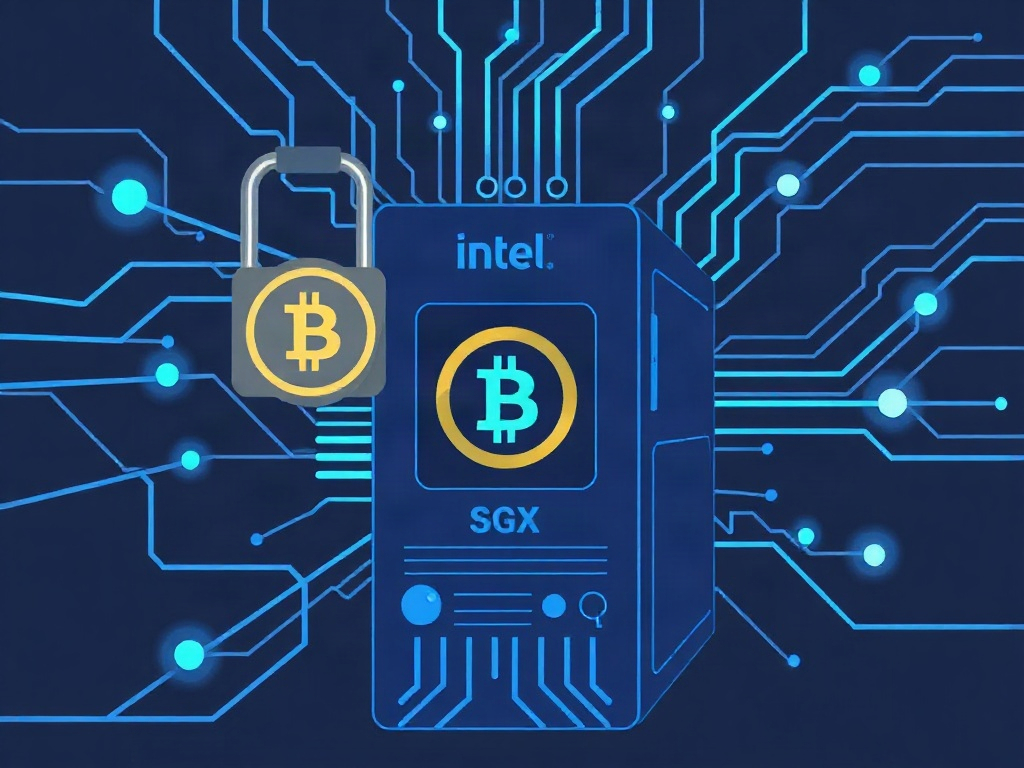
In the rapidly evolving digital economy, the intersection of hardware security and financial privacy has become a critical focal point. As cryptocurrency adoption grows, so does the necessity for robust privacy mechanisms that protect user data from prying eyes. At the heart of this technological arms race is the concept of intel sgx enclave privacy, a paradigm that shifts the security boundary from software-only protections to hardware-level isolation. For platforms operating in the cryptocurrency mixing sector—such as advanced Bitcoin mixing services designed to obscure transaction trails—integrating these hardware-based guarantees is not just an upgrade; it is a fundamental requirement for user trust.
Traditional cryptocurrency mixers rely heavily on cryptographic protocols and server-side logic to sever the link between the sender and the receiver. However, this approach inherently trusts the server administrator and the underlying operating system to maintain absolute confidentiality. When a user deposits Bitcoin into a mixer, the server must temporarily hold the funds and execute the complex shuffling algorithms. If an attacker gains root access to the server, they can potentially reconstruct the original transaction graph, deanonymizing the users. This is where the limitations of traditional software-based privacy models become apparent, necessitating a more robust architectural approach.
The Intersection of Hardware Security and Cryptocurrency Anonymity
The transition from conventional software privacy to hardware-anchored privacy represents a significant leap forward. Intel SGX enclave privacy offers a revolutionary method to isolate sensitive cryptographic operations from the rest of the system. By executing critical code within a secure region of memory known as an enclave, a system can guarantee that the data and code remain encrypted even from the system's own operating system. This directly addresses the vulnerabilities inherent in traditional mixing architectures.
Why Bitcoin Mixers Rely on Trust
To understand the necessity of hardware-backed privacy, one must first examine the fundamental mechanics of a Bitcoin mixer. The primary goal of a mixer is to break the deterministic link between a sender's input address and the recipient's output address. When a user initiates a transaction through a mixer, the service aggregates multiple users' funds, mixes them, and redistributes them. The security of this process relies on the assumption that the server does not log the intermediate states of the transactions. If the server is compromised, the mixing process becomes transparent, and the privacy guarantee collapses entirely.
The Vulnerabilities of Traditional Mixing Architectures
Historically, mixing services have operated under the assumption that the server infrastructure is infallible. Attack vectors include database breaches, legal subpoenas, and insider threats. Even with rigorous operational security, the fundamental design flaw remains: the server must observe the transaction data to execute the mixing algorithm. By moving this observation to a hardware-isolated environment, we can fundamentally alter the threat model. Instead of trusting the server, the user trusts the hardware manufacturer, creating a much more resilient privacy framework.
Decoding Intel SGX and Its Role in Data Protection
To appreciate the significance of intel sgx enclave privacy, it is essential to understand the underlying technology of Software Guard Extensions (SGX). Introduced by Intel, SGX allows applications to create secure enclaves—protected regions of code and data that are inaccessible to the standard operating system and other processes. This isolation is enforced at the hardware level, providing a root of trust that is significantly harder to compromise than traditional software sandboxes.
What is an SGX Enclave?
An SGX enclave is essentially a mini-computer running inside your computer. It operates independently of the host operating system, meaning that even if the OS is compromised by malware or a malicious actor, the enclave remains untouched. When an application needs to perform a highly sensitive operation, such as generating private keys or processing mixed transaction data, it transitions into the enclave. All cryptographic operations occur here, and the results are sealed—encrypted and returned to the untrusted world only when necessary.
Memory Encryption and Isolation
The cornerstone of the SGX architecture is its robust memory encryption. Data within the enclave is encrypted using ephemeral keys before being written to memory, and it remains encrypted while in the cache hierarchy. This means that a malicious process on the host system cannot read the memory contents of the enclave. For a cryptocurrency mixing service, this implies that the server cannot peek at the intermediate transaction states while the mixing algorithm is actively running. The privacy guarantee is no longer dependent on the integrity of the server's software; it is anchored in the silicon itself.
Implementing SGX for Enhanced Privacy in Crypto Services
Integrating intel sgx enclave privacy into a cryptocurrency mixing platform like btcmixer_en2 transforms the service from a vulnerable software construct into a hardened, privacy-first infrastructure. By encapsulating the core mixing logic within an enclave, the service can offer users a level of assurance previously thought impossible without decentralized trust models.
Secure Key Management Inside the Enclave
One of the most critical components of any mixing service is the management of withdrawal keys. If these keys are stored on a standard server, they represent a massive target for attackers. By utilizing an SGX enclave, the master key material can be securely generated and stored within the enclave's memory. The enclave can sign withdrawal requests using these keys without ever exposing the key material to the untrusted host. Furthermore, the enclave can enforce strict access controls, ensuring that only authenticated mixing requests are processed, thereby preventing unauthorized withdrawals.
Protecting the Mixing Algorithm from Tampering
A mixer's privacy is only as strong as the algorithm running it. If an attacker can modify the mixing algorithm on the server to retain a copy of the transaction mappings, the service becomes useless. With SGX, the entire mixing algorithm resides within the enclave. The host operating system cannot alter the code or inspect the data being processed. This ensures that the algorithm executes exactly as designed, providing a mathematical guarantee of privacy rather than a probabilistic one. Users interacting with btcmixer_en2 can be confident that the shuffling logic is immutable and secure against server-side manipulation.
Challenges and Future Directions for SGX Privacy
While the benefits of intel sgx enclave privacy are profound, implementing it in production environments is not without challenges. The very features that make SGX secure also introduce performance overhead, and the ecosystem surrounding enclave development requires specialized expertise. Additionally, the threat landscape is continually evolving, with attackers finding new side-channel vulnerabilities.
Side-Channel Attacks and Mitigations
The most pressing challenge for SGX is side-channel attacks. These occur when an attacker infers sensitive information by analyzing the time a computation takes or the power it consumes, rather than trying to read the data directly. For instance, an attacker might measure the execution time of a mixing algorithm to deduce the mapping of transactions. While mitigations exist—such as constant-time programming and data-independent table lookups—they require meticulous implementation by developers. Overcoming these vulnerabilities is an ongoing battle, requiring constant vigilance and updates to the SGX specification itself.
The Road Ahead for Enclave-Based Privacy Tools
Despite these challenges, the future of intel sgx enclave privacy looks exceptionally bright. As hardware manufacturers continue to refine SGX implementations and the developer community builds more robust frameworks, the performance gap will narrow. We are likely to see SGX integrated into standard cloud infrastructure, allowing users to spin up their own private mixing nodes without the risk of server-side compromise. The evolution of these hardware-backed privacy guarantees will redefine the trust model for digital asset transfers, shifting the burden of trust from the operator to the hardware.
Conclusion
The demand for unlinkable, private transactions in the cryptocurrency ecosystem has never been higher. As surveillance capabilities increase and regulatory pressures mount, privacy-preserving technologies must evolve beyond traditional software defenses. By embracing intel sgx enclave privacy, advanced mixing services can provide a fortress-like guarantee of anonymity. The integration of SGX ensures that the core logic of the mixer remains hidden from the host environment, effectively neutralizing the primary attack vector of server-side compromise. As the industry moves toward a more privacy-centric future, hardware-rooted security will become the gold standard for protecting user assets and identities.

intel sgx enclave privacy: Implications for Crypto Investors
I am Emily Parker, a certified financial analyst specializing in cryptocurrency investment strategies, and over the past decade I have helped both retail and institutional clients navigate the volatile digital asset market. In my experience, the integrity of trusted execution environments, particularly the privacy guarantees offered by Intel SGX enclaves, can materially influence the perceived security of blockchain‑based services and the confidence of capital allocators.
From a practical standpoint, when evaluating a project I examine whether its confidential computing architecture leverages Intel SGX enclave privacy to protect transaction data and private keys. If the enclave is properly implemented, it reduces the attack surface for side‑channel exploits and provides a hardware‑rooted trust anchor, which can justify a lower risk premium in my portfolio allocation models. Conversely, reliance on software‑only solutions without such enclave protections may warrant a higher discount rate or a more cautious position sizing.